
Sunday July 26 & bi-weekly * 11am * $5-10 suggested * REGISTER
How do different traditions across history and geography think about how we should live our lives?
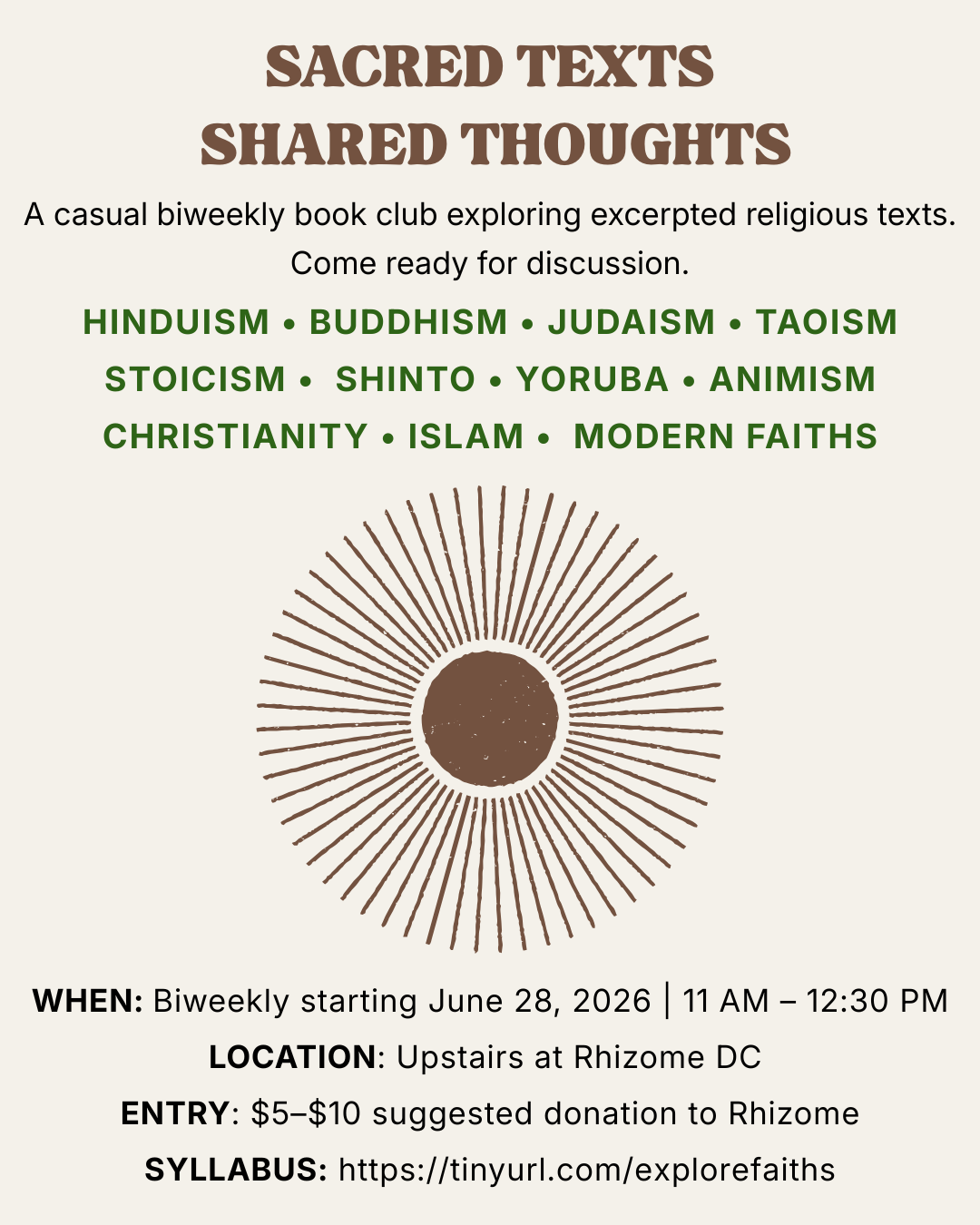
Join this community for a casual, biweekly discussion group dedicated to exploring the practical philosophies and lived wisdom of the world’s major spiritual traditions. Over the first 12 weeks, we’ll look at foundational ideas from Hinduism, Buddhism, Judaism, Taoism, Stoicism, Shinto, Yoruba, Animism, Christianity, Islam, and some modern faiths.
The full set of readings will comprise short, accessible excerpts of major texts. Because each of these traditions is vast and could inspire a lifelong study, our goal isn’t a dense deep dive. Instead, we want to look at the unique ways each tradition guides day-to-day living, ethical choices, and personal reflection.
This is less of a learning seminar and more of a conversational space. There are no right or wrong answers, and you don’t need any background in religious studies to participate. Come as you are, ready to chat about the ideas that jump out at you, what resonates with your own perspective, and how these philosophies might map onto our lives.
When: Biweekly starting Sunday, June 28, 2026, from 11:00 AM – 12:30 PM
Where: Upstairs at Rhizome DC (6950 Maple St NW, Washington, D.C. 20012)
Cost: Free to attend ($5–$10 suggested donation to support Rhizome's community space)
The initial syllabus is mapped out for 12 weeks with readings that are entirely free and available online, though a few weeks are still being finalized to ensure easy web access to readings. If interest sustains, we would love to keep the conversations going beyond the first 12 weeks!
Get Involved:
Check out the working syllabus and readings: tinyurl.com/explorefaiths
Join the community on Meetup: meetup.com/dc-religious-exploration-book-club/
Have questions, concerns, or reading suggestions? Reach out directly to crichardson1399@gmail.com
Shinto
Readings:
*The Kojiki The Door of the Heavenly Rock Dwelling, The Purification of the August Person
*The Kami Way, Chapter 5 (Dr. Sokoyo Ono)
*The Essence of Shinto, Chapter 2, Chapter 8 (Motohiso Yamakage)
Optional:
A youtuber I like called Religion for Breakfast has a whole playlist on Shinto. Thus far, I’ve found it to be an informative and engaging watch: Shinto Series
Summary:
Shinto centers on gratitude, harmony with nature, and living in the present moment. Our excerpts from The Kami Way and The Essence of Shinto establish the worldview of Shinto: a tradition with no fixed commandments or central holy book, rather exploring the ideas of how one might live. The selections from the Kojiki (the ancient, mythological chronicles of Japan), viewed through the lens of these modern readings, will reveal how these abstract philosophies are practiced in everyday life.
In "The Door of the Heavenly Rock Dwelling," we read a fable about isolation and community. When the Sun Goddess hides in a cave and plunges the world into darkness, the solution isn’t punishing the world, but finding collective joy and creativity through a festive gathering that coaxes the light back out.
With "The Purification of the August Person," we follow a creator god who returns from a dark underworld and immediately bathes in a river to reset himself. In Shinto, there is no concept of original sin; instead, negative emotions, failures, and burnouts are viewed simply as"spiritual dust" (kegare) or a temporary weathering of our energy that can be actively washed away (misogi).
Through these texts, we can explore how we handle our own dark periods and burnout. We could discuss our personal boundaries and resets, how we practice gratitude in our lives, and whether we can view our mistakes just as dust to be cleared away. Ultimately, these readings challenge us to reframe our relationship with our environment, finding sacredness in the everyday world around us and a transparent, cheerful peace within ourselves and with our community.