
Sunday June 28 & bi-weekly * 11am * $5-10 suggested * REGISTER
How do different traditions across history and geography think about how we should live our lives?
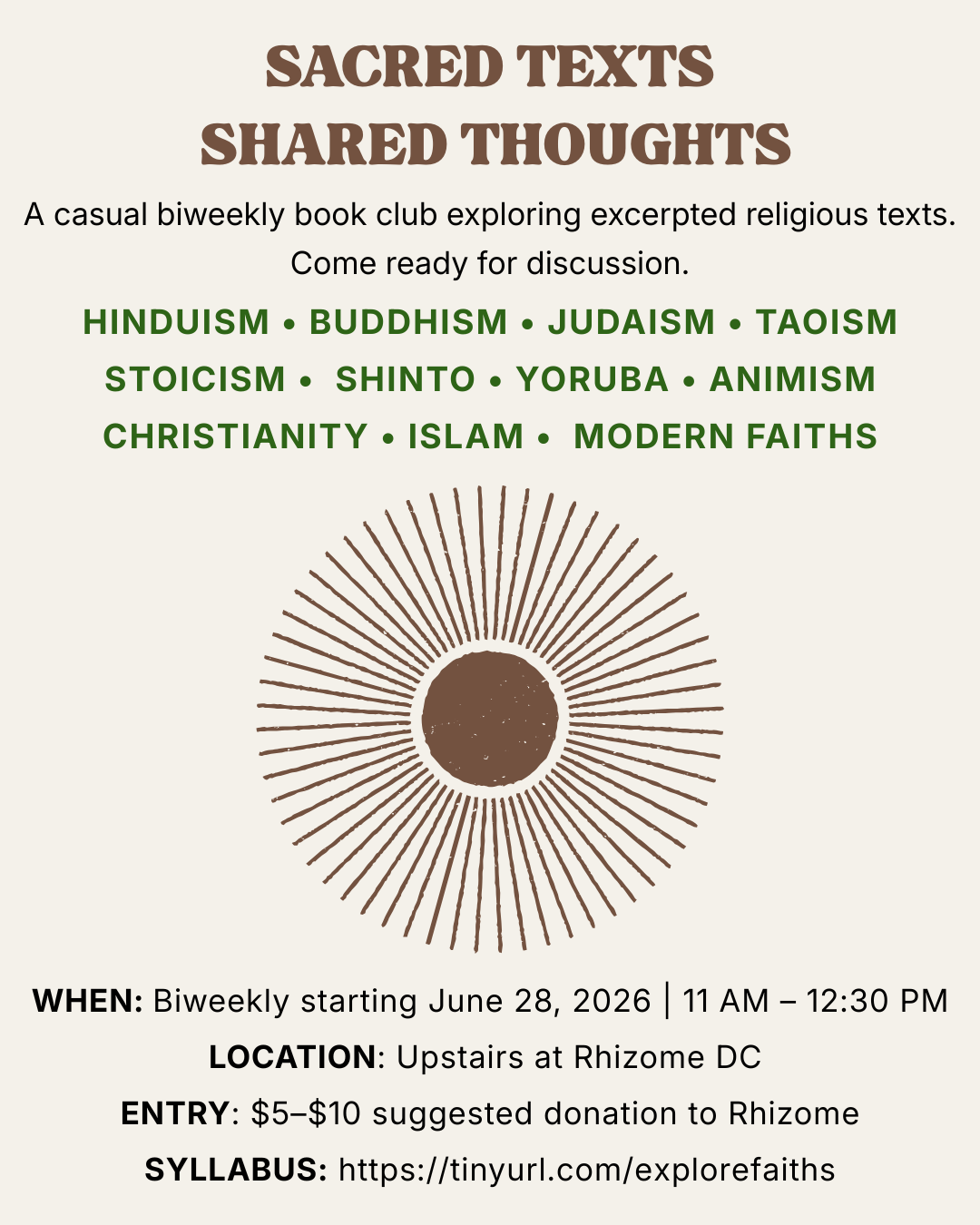
Join this community for a casual, biweekly discussion group dedicated to exploring the practical philosophies and lived wisdom of the world’s major spiritual traditions. Over the first 12 weeks, we’ll look at foundational ideas from Hinduism, Buddhism, Judaism, Taoism, Stoicism, Shinto, Yoruba, Animism, Christianity, Islam, and some modern faiths.
The full set of readings will comprise short, accessible excerpts of major texts. Because each of these traditions is vast and could inspire a lifelong study, our goal isn’t a dense deep dive. Instead, we want to look at the unique ways each tradition guides day-to-day living, ethical choices, and personal reflection.
This is less of a learning seminar and more of a conversational space. There are no right or wrong answers, and you don’t need any background in religious studies to participate. Come as you are, ready to chat about the ideas that jump out at you, what resonates with your own perspective, and how these philosophies might map onto our lives.
When: Biweekly starting Sunday, June 28, 2026, from 11:00 AM – 12:30 PM
Where: Upstairs at Rhizome DC (6950 Maple St NW, Washington, D.C. 20012)
Cost: Free to attend ($5–$10 suggested donation to support Rhizome's community space)
The initial syllabus is mapped out for 12 weeks with readings that are entirely free and available online, though a few weeks are still being finalized to ensure easy web access to readings. If interest sustains, we would love to keep the conversations going beyond the first 12 weeks!
Get Involved:
Check out the working syllabus and readings: tinyurl.com/explorefaiths
Join the community on Meetup: meetup.com/dc-religious-exploration-book-club/
Have questions, concerns, or reading suggestions? Reach out directly to crichardson1399@gmail.com
Hinduism (June 28, 2026)
Readings
* Chandogya Upanishad, The Story of Shvetaketu
* Bhagavad Gita (translation by Eknath Easwaran), Chapters 2, 3, 6*Note: You can download the EPUB file and upload it to epub-reader.online to actually view the book. The site is virus free, and this is the easiest option to view this version. The first contextual text will explain some about why we are reading this translation, but feel free to Google the author.
Contextual Texts
*Here you can read an overview of the setting and context of the Bhagavad Gita (link)Summary
Chapters 2, 3, and 6 set up some of the core tenets of Hinduism that continue to be built upon throughout the Bhagavad Gita. They also allow us to explore ideas that we will see consistently come up across different religions. Chapter 2 talks about the immortality of our souls. Chapter 3 outlines selfless action, telling us that we should perform duty without attachment to the results, surrender our fruits to the Divine, and avoid inaction. Chapter 6 gives us more technical motivation on the advantages of meditation, controlling the mind,and self realization. Through these texts we should be able to think about the nature of ourselves and actions, and discuss why we do the things we do, and the concept of a “soul”. We can also discuss experiences with mediation, controlling the mind (controlling emotions), and if anyone feels self realized.With “The Story of Shvetaketu” we follow a young man who is taught by his father that knowledge is more than just what we learn intellectually, rather it is about gaining understanding of the essence of existence. Here we get to explore fun philosophical concepts about what learning and knowledge truly is.
Ultimately, these texts challenge us to think about our agency by finding a sense of self-worth that exists independently of external notions of success or validation.