
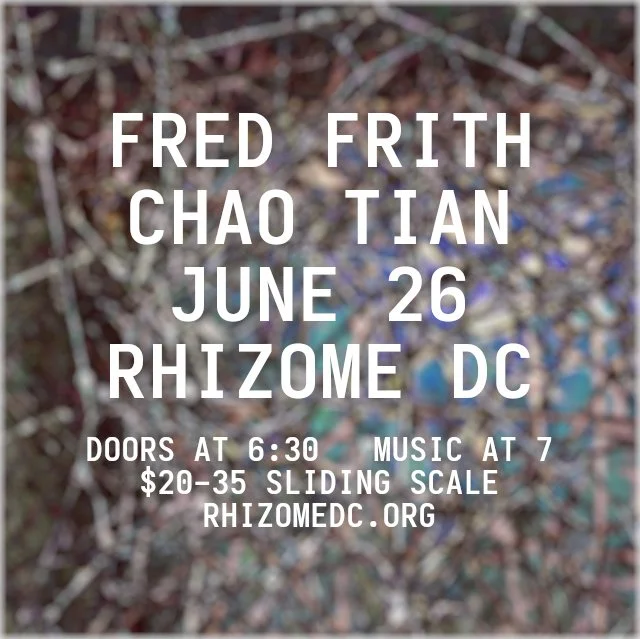
Friday June 26 * doors at 6:30, music at 7 * $20-35 * TICKETS
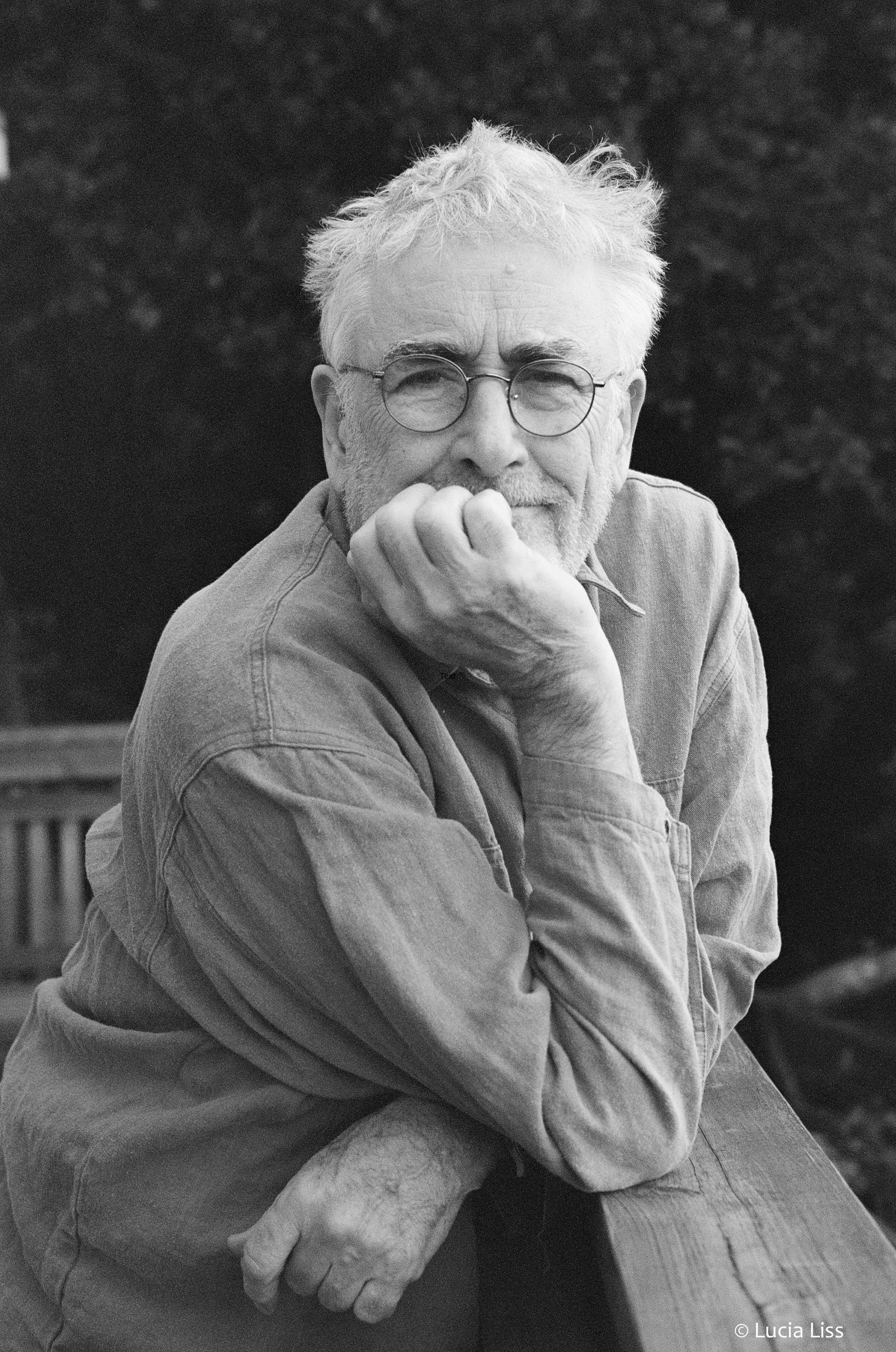
Multi-instrumentalist, composer, and improviser FRED FRITH has been making noise of one kind or another for more than 50 years, starting with the rock collective Henry Cow, which he co-founded with Tim Hodgkinson in 1968.
Fred is best known as a pioneering electric guitarist and improviser, song-writer, and composer for film, dance and theater. Through bands like Art Bears, Massacre, Skeleton Crew, the Fred Frith Guitar Quartet, Cosa Brava, and the FF Trio he has stayed close to his roots in rock and folk music while branching out in many other directions.
His compositions have been performed by ensembles ranging from Eclipse Quartet and the Bang on a Can All Stars to Concerto Köln and Galax Quartet, from the BBC Scottish Symphony Orchestra to the ROVA and Arte Sax Quartets, from Sleepytime Gorilla Museum and Ground Zero to the Glasgow Improvisers’ Orchestra.
Film music credits include the acclaimed documentaries Rivers and Tides, Leaning into the Wind, and Tracing Light, directed by Thomas Riedelsheimer; The Tango Lesson, Yes and The Party by Sally Potter; Middle of the Moment by Nicolas Humbert and Werner Penzel; as well as Penzel’s Zen for Nothing, Peter Mettler’s Gods, Gambling and LSD, and the award-winning (and Oscar-nominated) Last Day of Freedom, by Nomi Talisman and Dee Hibbert-Jones.
Composing for dance throughout his long career, Fred has worked with Rosalind Newman and Bebe Miller in New York, François Verret and Catherine Diverrès in France, and Amanda Miller and the Pretty Ugly Dance Company over the course of many years in Germany, as well as composing for two documentary films on the work of Anna Halprin.
Theater credits include François Chat’s Setaccio and François-Michel Pesenti’s Théâtre du Point Aveugle in Marseille, where he spent six months in 1990 working with “jeunes rockers en chômage des quartiers défavorisés” on the opera Helter Skelter.
Fred has performed works by and sometimes alongside composers John Luther Adams, Gavin Bryars, Sylvie Courvoisier, Alvin Curran, George Lewis, Annea Lockwood, René Lussier, Jose Maceda, Meredith Monk, Pauline Oliveros, Terry Riley, and Christian Wolff; improvised with Lotte Anker, Derek Bailey, Han Bennink, Peter Brötzmann, Lol Coxhill, Janet Feder, gabby fluke-mogul, Tim Hodgkinson, Joëlle Léandre, Phil Minton, Ikue Mori, Butch Morris, Bob Ostertag, Evan Parker, Zeena Parkins, Paula Sanchez, Susana Santos Silva and Camel Zekri, to name a few; collaborated with classical virtuosi Evelyn Glennie, Katia Labèque, Viktoria Mullova, and Werner Bärtschi; and—as session musician—recorded on albums by, for example, Brian Eno, The Residents, Robert Wyatt, The Swans, Violent Femmes, Material, Negativland, John Zorn, Matthew and the Unfortunates, and Half Japanese.
He is currently performing solo and with Normal (home-made instrument duo with Sudhu Tewari) and Frelonia (with Lotte Anker and Núria Andorrà), as well as in countless combinations of his favorite co-conspirators.
The recipient of Italy’s Demetrio Stratos Prize for his life’s work in experimental music and an honorary doctorate from the University of Huddersfield in his home county of Yorkshire, Fred taught for twenty years at the legendary epicenter of American experimental music, Mills College in Oakland, California; as well as co-directing (with Alfred Zimmerlin) the improvisation master’s program at the Musik Akademie in Basel, Switzerland. He is the subject of Nicolas Humbert and Werner Penzel’s much loved Step Across the Border, cited by Cahiers du Cinéma as one of the 20th century’s hundred most influential films.
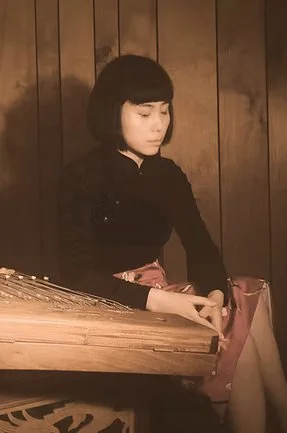
CHAO TIAN is a boundary-breaking Chinese dulcimer virtuoso, improviser, and sonic thinker whose music unfolds across tradition, experimentation, and diasporic imagination. Trained in the classical lineage of the Chinese dulcimer since the age of five, she now bends that legacy into new shapes—treating the instrument not as a symbol, but as a living, questioning voice.
Her creative work draws from intercultural collaboration and critical listening, engaging with sound as both form and encounter. She is the founder of Unheard Sounds, an ongoing initiative that explores how immigrant artists reshape artistic language through tension, resonance, and reinvention. Her signature project, From China to Appalachia, created with two-time GRAMMY winners Cathy Fink & Marcy Marxer, reimagines the meeting point between Chinese and American folk traditions through dialogue and shared musical roots. She also leads the cross-genre ensemble Always Folk and co-creates Dong Xi (East–West) with world percussionist Tom Teasley.
A former member of China’s renowned 12 Girls Band, Chao has performed across more than 30 countries. Her U.S. journey began as the first Chinese artist-in-residence at Strathmore Music Center (2017–2018), where she initiated bold collaborations across genres. She has since been a fellow at Art Omi, a NextLOOK artist at the University of Maryland, a Musician Changemaker Accelerator fellow (2024), and a GRAMMY U mentor (2025). Her studies with Karen Ashbrook in American hammered dulcimer, supported by the Maryland State Arts Council’s Folklife Apprenticeship, further expand her bicultural instrumental fluency.
Beyond performance, Chao is a scholar-practitioner whose work bridges artistic intuition and academic inquiry. She holds BA and MA degrees from the China Conservatory of Music and previously served as Director of the Arts Education Center at Beijing Language and Culture University. She is currently pursuing a Ph.D. in Ethnomusicology at Boston University.
Her research engages sound as both method and metaphor—a way of decoding belonging, voicing displacement, and composing new cultural grammars. It spans the expressive tension between structure and spontaneity, the linguistic textures of music shaped by migration, and the sensory entanglements of memory and movement. Through lecture-performances, writing, and public scholarship, she examines how diasporic artists reimagine inherited traditions in unfamiliar contexts—where regional musics converge, hybrid identities resonate, and the unsaid finds form through vibration.
To Chao, the dulcimer is not merely a vessel of tradition—it is a thinking body, a site where sound, identity, and memory are continuously refigured. Through structured improvisation, instrumental reconfiguration, and embodied experimentation, she treats sound as a mode of inquiry—an act of listening that resists fixed interpretation. Her artistic language unsettles inherited meanings and opens the Chinese dulcimer to new roles: as a migratory voice, a critical instrument, and a medium for reimagining how we dwell in sound.